Roscarte Coup
Overview
The Roscarte Coup, also recorded under the regime motto Viva la Maison du Roscarte, was the rapid and deliberately brutal dismantling of the Ehrengard Empire by House du Roscarte under Seraphine du Roscarte. Over the course of a single campaign it executed the Empire's Secretary of Defense, forced the abdication of Empress Avery R. Ehrveil, dissolved the imperial administration, outlawed the name Ehrengard, and erased the Ehrveil dynasty from the official record. The state that took Ehrengard's place was Sovarre, a dominion ruled through fear, calculated violence, and the spectacle of obedience.
The Roscarte Coup is unusual in the historical record because its political mechanics, ruthlessly competent though they were, were not the actual cause. The Empire fell because one woman who had been trusted with everything decided that if she could not be loved in return, no one would be allowed to live in the world her beloved had built.
Prelude
Ehrengard's Weakening Grip
By the time of the coup, Ehrengard was already faltering. Noble factions were divided between loyalists pursuing reform and opportunists waiting for any opening to widen. Avery's reign, while idealistic and broadly popular among the lower nobility and commoners, was read by traditionalists as too restrained to hold an empire built on strength. House du Roscarte had been operating in the political shadows for some time, building a quiet web of conspirators, financial leverage, and military defectors. The political conditions for a coup existed before Seraphine ever decided to launch one.
This is the version of the story preferred by the historians House du Roscarte left behind to write it. The other version is also true, and both were taught to Lilarisi children as a cautionary tale once Ehrengard was finally retaken.
Seraphine's Breaking Point
Seraphine du Roscarte had served as Avery's right hand throughout the early years of her reign, the velvet glove that handled what the Empress's idealism could not. The two were close in a way that those around them noticed without ever naming. Seraphine lingered. Her sharpest words softened when she spoke to Avery. Her presence at Avery's side at gala after gala, dinner after dinner, was a fact of court life that everyone accepted and no one explained.
When Avery fell in love with Isaac Acentino, Seraphine read it as a betrayal twice over. Officially, she framed it as proof that Avery had chosen sentiment over the discipline an empire required. Privately, the choice meant something simpler. Avery had finally chosen, and she had not chosen Seraphine.
What followed was not the abandonment of devotion; it was its inversion. Seraphine remained, in the part of herself that wrote letters and laid plans, in love with Avery from that day until the end of her life. The coup was that love mutated into its other shape. If she could not have Avery, the empire Avery had built and the man Avery had built it for would not be permitted to continue existing.
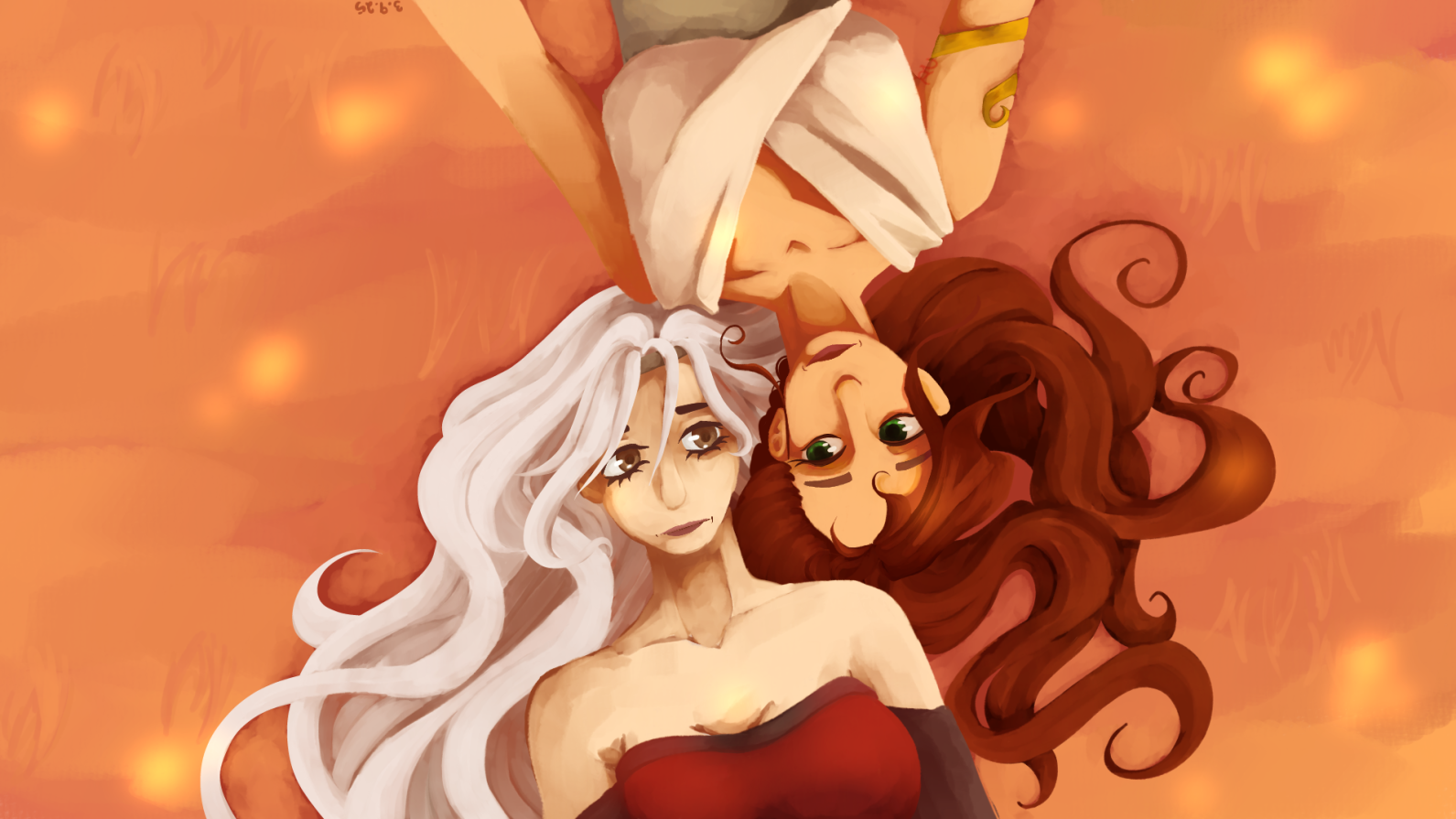
Empress Avery (right) and Viscountess Seraphine, from the years before. Art by TheRedCookie.
The political pretext, the weakening grip and the divided nobles, became the costume. The motive was personal. House du Roscarte's other principals, Enzo du Roscarte in the military and Étienne du Roscarte in the finances, knew exactly what they were enabling. By the time the coup was set in motion, they did not need to be told.
The Takeover
Phase One: The Killing Blow
"The first step to killing an empire is to kill its sword."
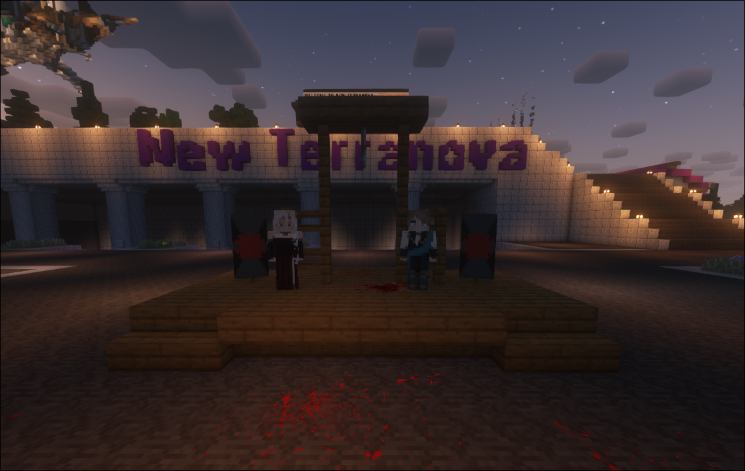
Porter Ehrveil, Secretary of Defense and Avery's strongest ally, was lured into a trap under false pretenses. Enzo du Roscarte executed him publicly, in the open, with the body left on display as a warning to every officer and noble who might have considered resistance. State propaganda labeled Porter a traitor within hours, ensuring that no military leader would risk being seen mourning him.
The public execution was unnecessary as a tactical measure. Porter had no escape route, no shielded loyalists capable of rescue, no second move. The execution was a performance, and the audience was the rest of the Empire. Seraphine wanted the corpse to be the thing everyone remembered. She wanted the message of the regime to be carved, before its name was ever spoken, into the public's nervous system.
It worked. Avery lost her strongest defender, the imperial capital became indefensible, and the rest of the noble class read the message exactly as intended.
Phase Two: The Seizure of the Imperial Palace
"Ehrengard did not fall in battle. It was abandoned by its own ruler."
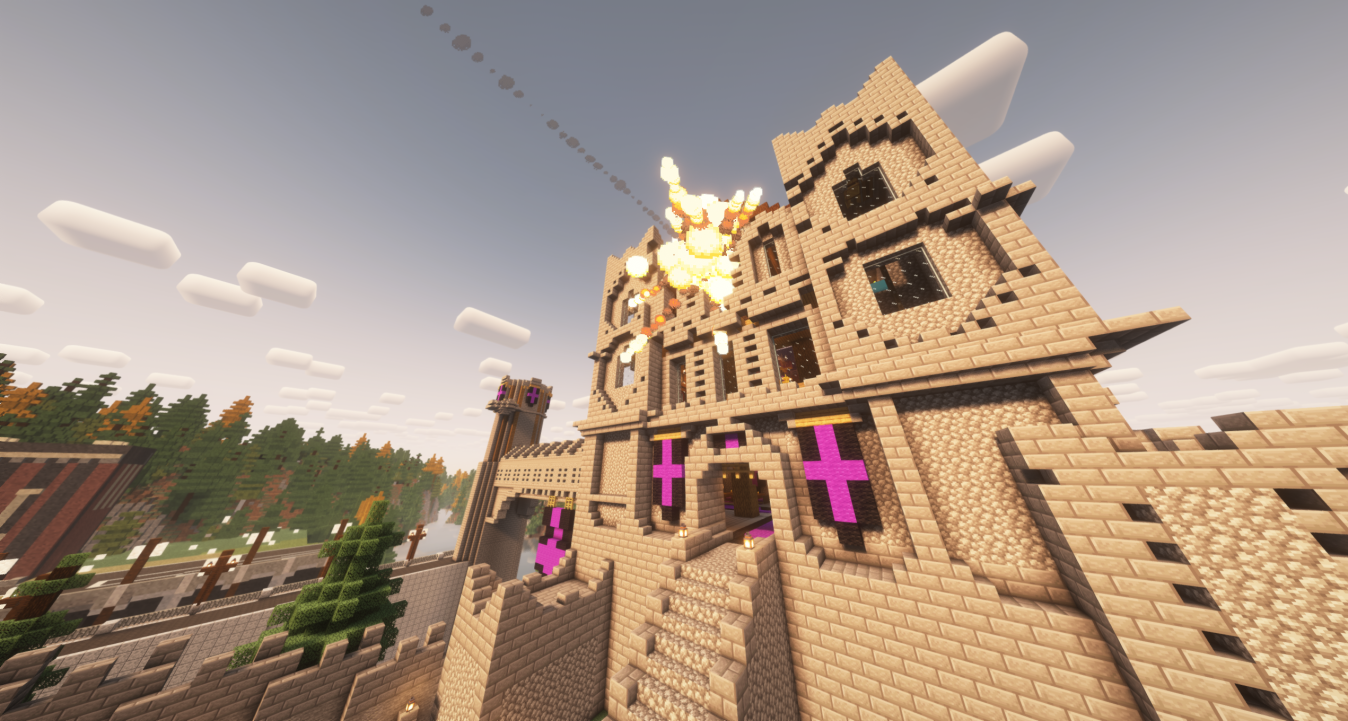
With Porter dead, Seraphine's forces stormed the capital and took the Imperial Palace in New Terranova with almost no resistance. Avery, surrounded by advisors who could no longer protect her and a noble class that had read the message of Porter's body correctly, fled into exile rather than die at her own throne. Before the sun rose, the Ehrveillian Dynasty had ended in any practical sense. Seraphine stood in the throne room.
The propaganda that followed reframed Avery's flight as cowardice. The choice she had actually faced (die for an Empire whose entire military leadership had just been demonstrated unable to save her, or live and try to undo what had happened) was not part of the official record.
Phase Three: Dismantling the Empire
"You served the empire. Now, you serve me."
The remaining nobles and generals were summoned to the capital and given the choice that Seraphine intended to become the regime's defining ritual: swear fealty to House du Roscarte, or die.
Many swore. Some refused. The refusals were not negotiated. The imperial bureaucracy was dissolved, the old administrative apparatus stripped to its bones, and the Ehrengard Empire was formally declared dead. All official records of Avery R. Ehrveil and the broader Ehrveillian Dynasty were erased, scrubbed from registers, struck from official histories, and removed from monuments. To speak the old names became an offense.
This was the part of the campaign Seraphine had reportedly planned in the most detail. The point was not merely to take power. The point was to make the world in which Avery had been loved by her people stop existing.
Phase Four: The Birth of Sovarre
"There is no empire. No emperor. Only Sovarre."
The name Ehrengard was outlawed and replaced by Sovarre, a dominion under House du Roscarte. All Ehrengardian banners, statues, and royal insignia were destroyed or defaced. Enzo du Roscarte took formal command of the military and enforced Seraphine's rule with the brutality the Porter execution had established as the regime's grammar. Étienne du Roscarte consolidated the economy, restructuring trade and noble debts to ensure that every meaningful actor in the new dominion was financially dependent on House du Roscarte.
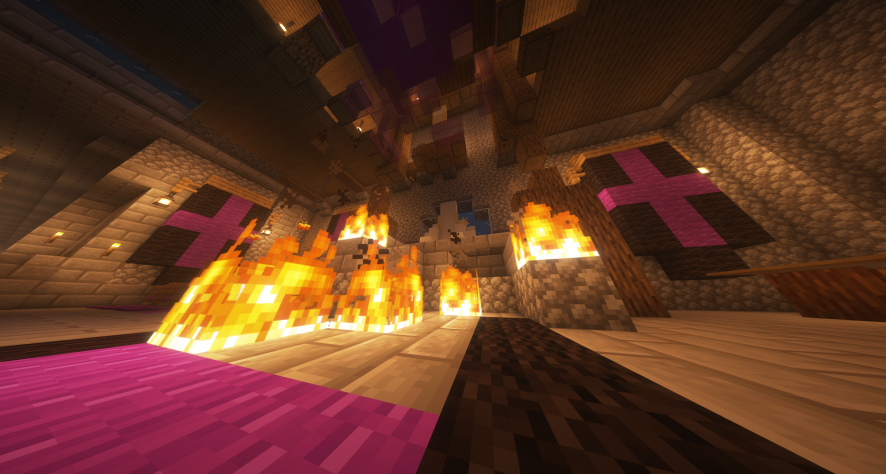
Seraphine convened what came to be called the Blood Court, an internal tribunal nominally for disputes among the new fealty-bound nobility. In practice it was the apparatus by which she selected who in the surviving noble class lived comfortably, who lived in fear, and who did not live at all. The Blood Court did not maintain written records, as it was a subject to Seraphine's whims.
The Cost
To Avery
Avery fled to New Ides, where she was sheltered by Isaac Acentino until the resistance could be organized. The Empire she had been raised to inherit, the office she had earned through her years as Duchess of Varenholde, the public she had served, the uncle who had defended her, and her own legal identity in the historical record were all taken from her within the span of weeks. She did not break. She wrote The Testament of Avery Ehrveil, and a Path to Salvation during her exile and made the case for the new political order that would eventually become The Second Lilaris Empire.
She was killed by a bomb during her victory speech in the retaken palace, before that order could be founded under her own hand. Her young daughter Kara A. Ehrveil was in the room.
To Seraphine
Seraphine got everything she said she wanted. She held the throne and ruled through fear. She had outlasted the woman who refused her. None of it appears, from the available records, to have made her well. The years that followed are punctuated by reports of increasingly erratic behavior, of conversations conducted with people who were not in the room, of moments when courtiers heard her speaking to Avery as though Avery were still present. After the Night of the Veil, during which Seraphine personally executed the operation that killed Isaac Acentino (Avery's father,) witnesses reported what one Imperial intelligence officer mentioned "psychotic episodes" and "whispers of Seraphine du Roscarte" associated with the brutal destruction of former Larrist settlements.
The Blood Court continued to operate. So did Seraphine. Whether the woman who had served as Avery's right hand still existed inside the sovereign of Sovarre, or had been replaced years earlier by what was left after the choice, is the question that survives her.
The Recapture
The resistance retook the palace in New Terranova during the late imperial-era reconstruction effort that would eventually become The Second Lilaris Empire. The fighting was prolonged and brutal. Among the casualties on the Roscarte side was Amelie du Roscarte, a less prominent House du Roscarte figure who fell during the assault on the throne room in circumstances no one was able to reconstruct after the fact. No one ever claimed her death but the throne room floor required a full restoration, especially after a bomb under the dias killed Avery during her victory speech. Sovarre, as a coherent political entity controlling the capital, ended in the recapture.
It did not end as a faction. Rumors persisted, and persist still, that Sovarre survived in the shadows under House du Roscarte's continuing influence. Whether those rumors are accurate or are the residue of what Seraphine wanted everyone to believe about her is unresolved.
Philosophical Aftermath
The Roscarte Coup poses a set of questions that the subsequent canon has never fully resolved.
The first is whether love, of the kind Seraphine carried, is meaningfully distinct from the destruction it produced. Seraphine framed the coup in the public record as a political correction. Her own private behavior, before and during and after, suggests the personal motive was primary. If a person spends every public moment of their adult life loving a sovereign and every private moment unable to admit it, and then destroys that sovereign's entire world the day they choose someone else, is the destruction itself the love made legible, or is it the failure of love to become anything else?
The second is whether the noble class that swore fealty to Sovarre bore the moral weight of what followed. Most of them survived because they swore. They retained titles, lands, and lives because they did not become the next public corpse. They later swore again to Lilaris when the resistance retook the capital. None of them were prosecuted. The principle that fealty under duress is not fealty has the unspoken corollary that nothing was ever actually owed in the first place. Lilarisi legal scholars have argued about this for the entirety of the late epoch.
The third is whether Avery, who chose Isaac and never returned Seraphine's regard, bore any responsibility for what her refusal triggered. The respectable answer is no. The harder answer, the one Lilarisi historians offer only in private, is that she had known. She had known the way a sovereign always knows about the people closest to her, and she had not chosen to speak. Whether speaking would have changed anything is impossible to determine.
There is no clean reading of the Roscarte Coup. There is only the question, in many forms, of what it costs to be loved like that and what it costs to love like that, and the answer in either direction is the same answer: everything.
Trivia
- The execution of Porter Ehrveil was the first public display of the new regime's power. His last recorded words were: "Ehrengard will not die with me."
- The phrase "Vive la Maison du Roscarte!" became the rallying cry of Sovarre and the closing formula of internal correspondence under House du Roscarte. It is still considered offensive speech in Lilaris.
- Seraphine reportedly kept a portrait of Avery in her private chambers throughout her reign over Sovarre. The portrait was never confirmed to have been destroyed.