Content warning
Depictions of systemic abuse, forced labor, environmental collapse, the elimination of currency in favor of subsistence-by-compliance, suicide (including the corporations’ protocols for managing the rate and the bodies), the gendered structural pipeline that places marginalized people into survival sex work (treated in detail in What Camina Carried), and the corporations’ treatment of workers who can no longer be extracted from. It is written carefully but it does not soften these subjects.
Support and a note on fiction
If any of this material is close to your own experience of structural exploitation, suicidal thinking, environmental dispossession, or labor coercion, please consider returning to this article at a time when it is safer for you to engage with it, and reach out to a mental health professional, a crisis line in your country, or someone you trust if you need support.
Like every page on this wiki, the article is fiction set within the lore of Landfall. The conditions described here are not statements about any specific present-day city or corporation, though readers may find them resonant with structural patterns they recognize from contemporary life.
Overview
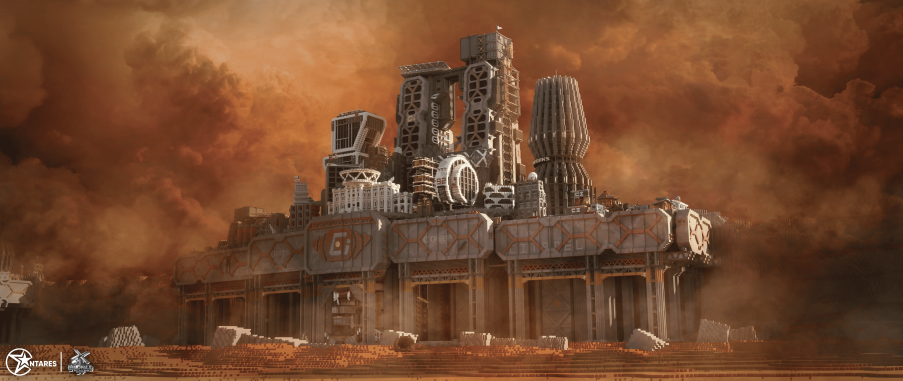
Echo Sprawl is a corporate-controlled arcology and one of the last functioning refuges on post-The Blaze Earth. Originally constructed by Citadel Corporation as a hyper-optimized labor extraction facility, it has evolved into a self-contained city-state where survival comes at the cost of freedom. The sprawl represents the ultimate consequence of unchecked corporate power in the wake of humanity’s collapse from its zenith during Landfall-530 - Noble Blood.
History
During humanity’s golden age, great powers like The Second Lilaris Empire, Starspire, New Ides, and the Mirage Concord flourished under the guidance of the Divinets—AI gods linked to genetically attuned humans. When The Blaze destroyed this civilization, the corporations that built Echo Sprawl filled the power vacuum, transforming their industrial complex into humanity’s refuge-turned-prison.
Citadel Corporation initiated the sprawl’s construction, with Oki Engineering and Goldworks later buying in to develop their own towers within the complex. What began as competing corporate interests merged into a unified system of control when traditional governance collapsed.
Structure and Stratification
The Penthouses
Above the smogline, the corporate elite inhabit pristine towers with white walls and wellness-retreat aesthetics. Here, natural sunlight still reaches, and the air remains breathable without filtration. The executive levels of Citadel, Oki, and Goldworks towers compete for height and luxury.
The Middle Rings
Working-class apartments form a gray circle of concrete and glass between the penthouses and the Shaft. The windows are deliberately angled downward into the slums below, a design choice the corporations describe in internal documents as “motivational sightlines” and the residents describe as the reason they keep the blinds down. The units are cramped, colorless, and the same template repeated across the ring whether the resident is alone or housing a family. Most residents prefer their office cubicles to their homes and dread the daily descent.
The bridges between the middle ring and the working towers have become the sprawl’s most-used suicide infrastructure. The three most-used are named Citadel Cross, Oki Walk, and the Goldworks Span. Cleaning crews arrive in the Shaft below them at 04:00, before the first shift, and the bodies are not displayed and not mourned in any official record. Goldworks’s standing protocol classifies a death-from-bridge as a contract termination, which means the family of the dead is liable for the deceased’s outstanding subsistence balance unless they can prove the contract was mutually dissolved before the jump. They cannot prove it. The balance transfers. The middle-ring rate of suicide is the highest in the sprawl per capita, and the inherited debt is the most common single reason a former middle-ring family ends up in the Shaft.
The three corporations have, between them, debated installing nets under the spans for approximately fifteen years. The debate has not concluded. The arguments against installation are that nets attract attention from outsiders, that nets are read by current workers as evidence of leadership’s bad faith, and that nets impose a maintenance cost that none of the three has been willing to absorb alone. The argument in favor of installation is that bodies in the ducts below the spans damage equipment. The equipment argument has not won.
The Shaft (The Slums)
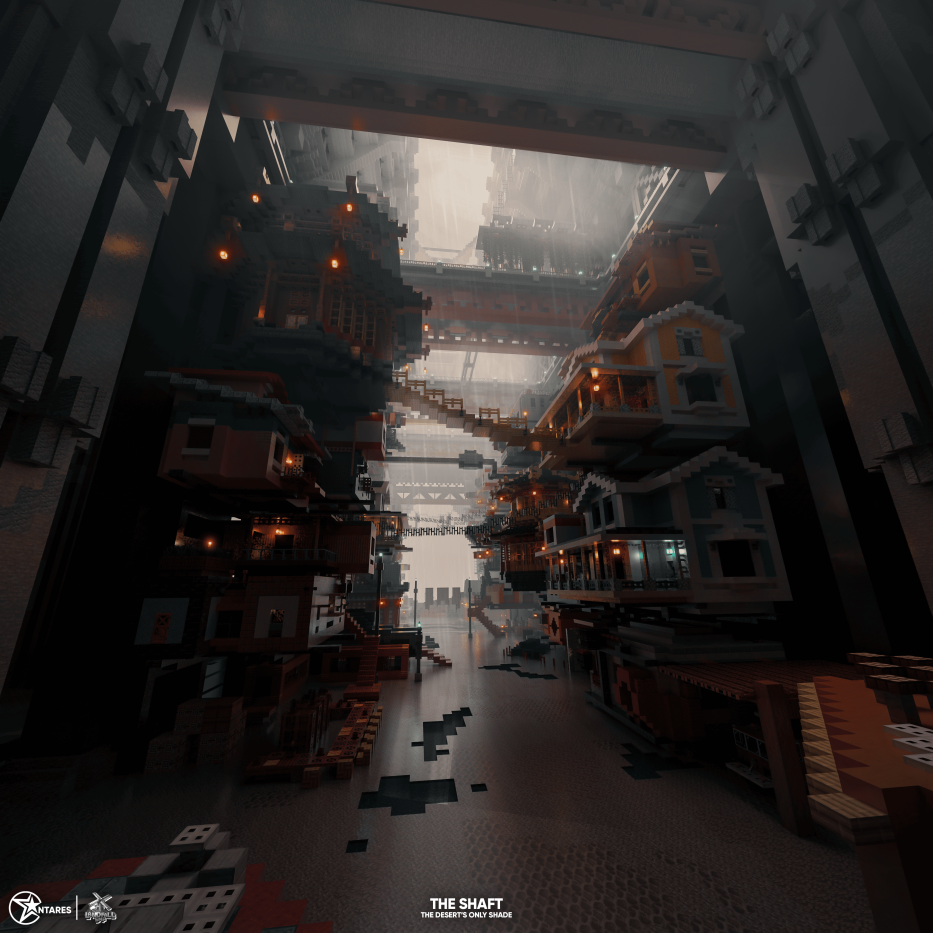
The sprawl’s cargo and machinery bays were hastily converted after The Blaze, with makeshift homes now precariously balanced on industrial forklift pallets welded to support beams. This lightless warren houses the majority of Echo Sprawl’s population. Children are born to subsistence contracts inherited from their parents and live their entire lives without seeing natural sunlight. The first generation to know nothing but the Shaft is now older than the Shaft itself in any practical sense; the people who remember outside light are nearly all dead.
The acoustics of the turbines, even at minimal capacity, create a sonic floor that no resident escapes. Dubious liquids drip from the levels above, some from condensation off the cooling lines, some from the middle ring’s sanitation gray-water leaking through unsealed seams. Children learn early which drips can be drunk from a cupped palm and which cannot. The catchment cup is the first family-heirloom object a Shaft child is given. Most still have theirs at thirty.
Market stalls cling to terraces between megastructures as propaganda drones circle endlessly, their speakers crackling with messages of obedience. The drones cycle through twelve standard messages on a fixed rotation. Residents who have lived in the Shaft for more than a few years know the cycle by heart and time their private conversations to the brief gaps between announcements, which is the only way an exchange unmonitored by the corporations can occur within drone range. The corporations describe the drones as a safety measure. The residents describe them as a leash with a sound.
The Turbine System
Four massive turbines once powered Echo Sprawl by channeling water into shafts reaching the upper mantle, instantly vaporizing it for steam power. This system consumed all regional water over decades, creating the vast desert surrounding the sprawl and leaving the turbines operating at minimal capacity. Water scarcity has become another tool of corporate control, with Citadel, Oki, and Goldworks jointly managing what remains.
Life Under Corporate Rule
The three megacorps have eliminated currency, replacing it with labor-for-subsistence contracts. Citizens learn from birth that work is purpose and survival is nobility. The corporations provide shelter, synthetic food, and protection from the wasteland, but only through absolute compliance.
Those who question the system become cautionary tales in fear campaigns. Despite the propaganda, whispers persist of life beyond the sprawl. Trailblazers still vanish into the shadows, slipping through cracks in Echo Sprawl’s concrete shell. For now, travel remains technically unrestricted, the corporations confident that their citizens are too broken or terrified to leave.
Labor Contracts
The currency Echo Sprawl eliminated has not been replaced by a more honest form of value exchange. It has been replaced by contracts: lifetime agreements between a worker and one of the three corporations, in which the worker commits their hours, their body, and their compliance in exchange for shelter, synthetic food, breathable air, and the protection of the corporate identification chip without which a person cannot move between sectors.
The contracts are tiered. Tier I maintains the sprawl’s heavy machinery and the turbines; it is the highest-paying tier and the most dangerous, with a documented but unpublished mortality rate. Tier II is service labor in the penthouses and middle ring: cleaning, food preparation, security, and the personal-attention industries that include but are not limited to sex work. Tier III is sanitation, recycling, and the disposal of the corporations’ inconvenient materials, which include their dead. Tier IV is the unsorted category, into which the recently-of-age, the recently-injured, and the recently-non-compliant are placed pending re-categorization. The Tier IV pool is also the reservoir from which the corporations draw for the work that does not fit into the other tiers, which is to say the work no formally-employed person would do voluntarily and for which the corporations need a reliable supply of people whose alternatives are worse.
A contract cannot be terminated by the worker. It can be terminated by the corporation, which is one of the formal pathways into expulsion from the sprawl. Expulsion is to the wasteland, and the wasteland does not return what it takes. The other formal pathways out are death and re-categorization, both of which are administrative events the corporations process and do not announce.
The category line between Tier II personal-attention and Tier III disposal labor is finer than the corporations admit. A worker who develops a condition the personal-attention market reads as a defect is moved to disposal. A worker in disposal who shows the kind of bearing the personal-attention market wants is sometimes moved up, on a discretionary basis the corporations describe as merit and the workers describe as the most reliable lottery in the sprawl. Both directions of movement are common. Neither is dignified.
For instance, Camina Gravacs entered the sprawl’s economy in Tier II personal-attention because the corporations’ intake protocols placed trans women there by default due to their frequent and often default perception as sexual objects. She did not choose the tier any more than she chose the city. The city had placed her in advance. The full account of what that placement cost her is in What Camina Carried.
The Corporate Trinity
Citadel Corporation maintains the sprawl’s infrastructure and security systems. Oki Engineering manages the failing turbines and rationed utilities. Goldworks controls food production and distribution. Together, they form an unbreakable monopoly on survival itself, each dependent on the others, yet competing for dominance within their shared domain.
Cultural Decay
Echo Sprawl exists as civilization’s hollow echo, where human dignity has been traded for efficiency. The endless cycle of labor and subsistence has produced a society where hope itself has become contraband. The corporations do not need to prohibit hope. They have only to ensure that the conditions which produce it are absent.
With no government to regulate them and no competition to challenge them, the three corporations have achieved the ultimate market monopoly: not on goods or services, but on existence itself. The sprawl stands as the most efficient labor-extraction system humanity has produced. It works.
The myth of something better persists, but the corporations no longer treat the myth as a threat. They have learned that hope, kept abstract and aspirational, is a stabilizer rather than a destabilizer. A population that believes a better world is theoretically possible is more compliant than one that has stopped believing, because the belief produces patience. The corporations count on this. The patience has, so far, held.
Attribution
Concept and worldbuilding developed in collaboration with the wonderful Antares BT, whom Landfall commissioned for the final Minecraft structure.